
A parking system is a coordinated set of equipment and software that manages how vehicles enter, park, pay when required, and leave a facility. It can include vehicle detection, license plate recognition, tickets or registered credentials, barriers, payment equipment, space guidance, and operator records. Each site uses the layers it needs.
The term has several meanings. A parking management system controls vehicle access and parking activity. An automated garage stores and retrieves vehicles with mechanical equipment, while in-car parking features help a driver position a vehicle. This article focuses on facility management.
What Does the Concept of a Parking System Mean?
The concept is simple: connect the vehicle, the parking lane, the space information, and the operator’s rules in one workflow. A barrier unit alone controls a lane. The full parking system adds identification, records, payment status, and guidance where the project requires them.
Parking Management, Automated Parking, and In-Car Parking Are Different Concepts
A parking management system manages spaces that drivers use themselves. An automated garage uses lifts, shuttles, conveyors, or similar equipment to move vehicles into storage. In-car parking uses sensors and software inside the vehicle. Their equipment and project requirements differ.
The Parking System Links Several Components
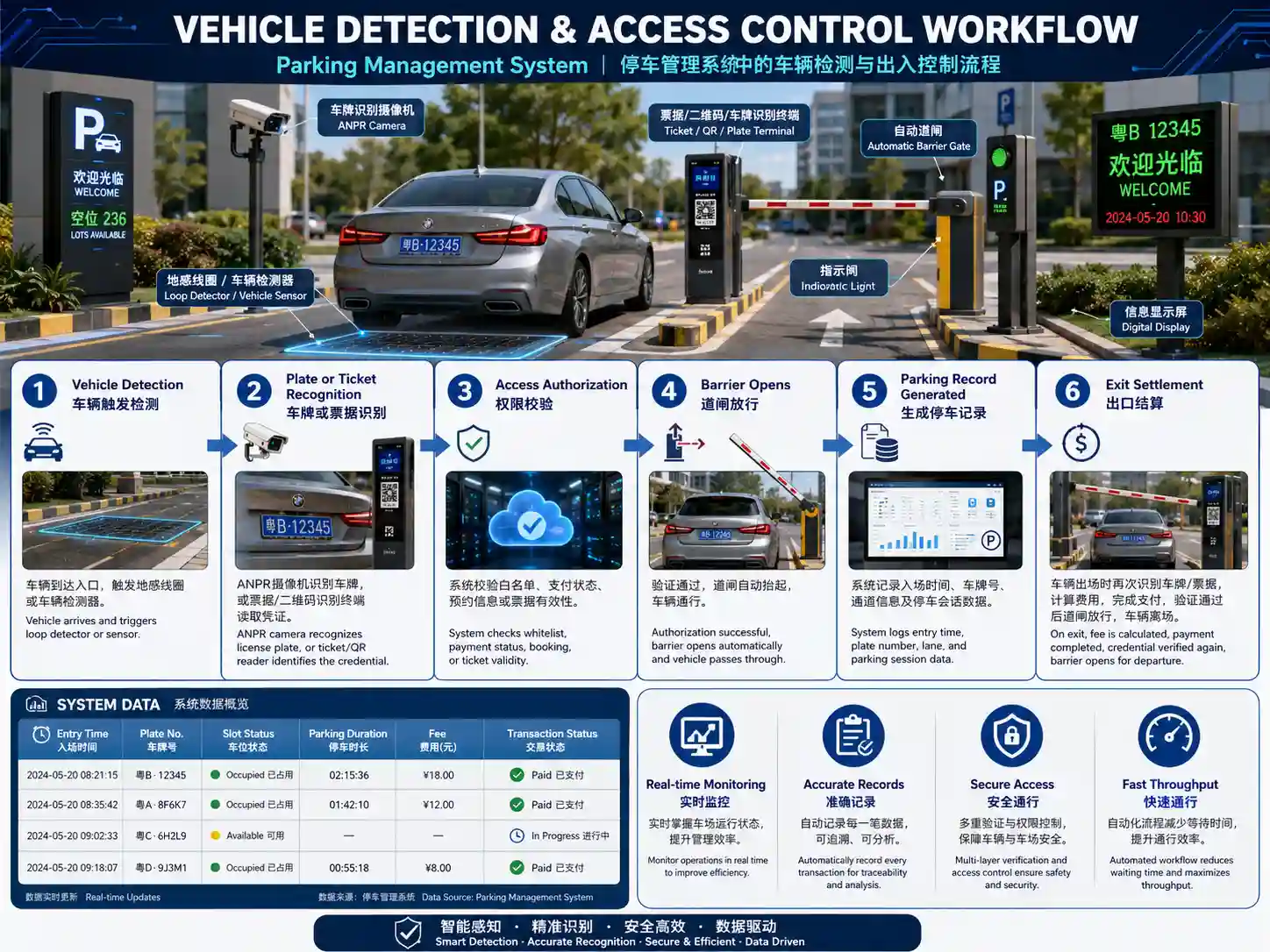
At an entrance, a detector or camera recognises a vehicle. The system checks a plate, ticket, card, tag, or account, then commands the barrier and creates a parking session. Payment status, exit validation, and space data can update the same record.
How Does a Parking System Work for One Vehicle?
One vehicle process makes the concept easier to picture. The exact sequence changes with the access method and local operating rules.
Vehicle Detection and Entry Request
The entry lane needs a trigger. A loop detector, radar, camera, ticket-button action, or reader can tell the controller that a vehicle is present. Detector placement and approach space belong in the design review.
Identification and Access Decision
The vehicle may use a license plate, ticket, RFID card, UHF windshield tag, or Bluetooth credential. TigerWong materials list multi-country plate recognition with API and SDK interfaces for ALPR software. Documented RFID interfaces include RS485, Wiegand 26, Wiegand 34, and relay barrier control.
Barrier Opening and Parking Session
An approved result sends an opening signal to the barrier. Selected models list parking-system interfaces plus relay or RS485 control. Software can link a session to a ticket, plate, credential, or account. Define responses for mismatches, unreadable plates, and manual release.
Payment, Exit Verification, and Barrier Reset
At exit, the system checks the session against the selected rule. A ticket system scans the ticket, while a plate-based system matches the exit plate to the record. Payment may occur at a terminal, on exit, through a digital flow, or under a permit rule. The barrier then resets for the next vehicle.
Which Components Make Up a Parking System?
The system has several layers. A small site may use only lane equipment and a simple access rule. A larger facility can add payment, space guidance, reporting, and interfaces to other software.
| System Layer | Typical Equipment | Main Job |
|---|---|---|
| Vehicle access | Camera, reader, ticket dispenser, barrier, detector | Identify the vehicle and control entry or exit |
| Parking management | Controller, software, database, operator interface | Apply rules and store parking-session information |
| Payment | Payment terminal, ticket scanner, receipt printer | Confirm a payable session through the selected payment flow |
| Guidance | Ultrasonic detector, indicator, controller, display | Collect space status and show available-space information |
Entry and Exit Lane Equipment
Entry and exit lanes combine equipment with control signals. TigerWong materials describe an entry ticket dispenser and exit ticket scanner. Selected barriers list infrared anti-strike input and manual opening. Review parking management system options by lane workflow.
Parking Management Software and Interfaces
Software joins events from cameras, readers, barriers, payment equipment, and operator actions. It applies access rules and stores parking-session information. API and SDK describe software connections; relay, RS485, Wiegand, CAN, Ethernet, and wireless links apply to different hardware arrangements.
Parking Guidance and Occupancy Equipment
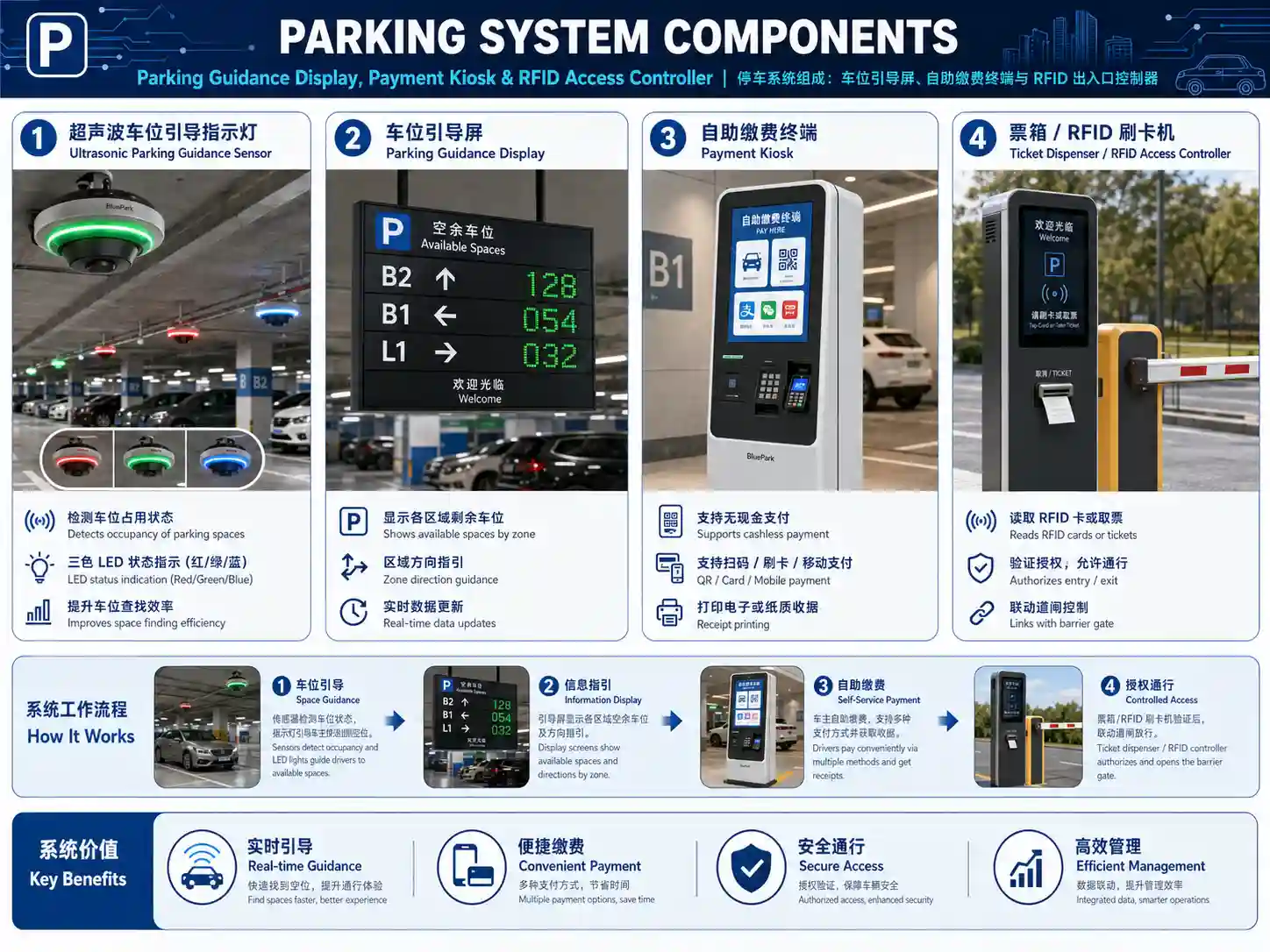
Parking guidance reports space status and directs drivers. Documented equipment includes ultrasonic detectors, indicators, node controllers, central control, and guidance displays. Links can use RS485, CAN, Ethernet, or wireless by component. Use parking guidance system equipment when occupancy information is required.
How Do Common Parking Access Methods Work?
Each method identifies a vehicle or validates a parking session. Fit depends on local plates, user groups, visitor traffic, payment flow, privacy requirements, and existing software.
License Plate Recognition Parking Systems
An ANPR or ALPR camera sends a plate result to parking software. The software compares it with a permitted list, active session, reservation, or payment record. Provide local plate samples, entry and exit directions, privacy rules, and the interface. Review ANPR and ALPR parking systems for plate-based access.
Ticket Parking Systems
A ticket method issues a ticket at entry and verifies it at exit. Site rules should cover a lost ticket, damaged barcode, payment exceptions, and re-entry.
RFID, UHF, and Bluetooth Parking Systems
Registered vehicles can use an RFID card, UHF windshield tag, or Bluetooth credential. The project needs an enrolment process, visitor route, and fallback for a missing, expired, or unreadable credential.
How Do Payment and Parking Guidance Fit Into the Concept?
Payment and guidance support the same facility with different jobs. Payment confirms a charge rule; guidance shows available-space information. A site can use either layer or both.
Parking Payment Equipment
The AP101P self-service payment machine lists bank-card, QR-code, cash, coin-change, receipt-printing, and IC or ID functions for supported configurations. Define currency, tax, refunds, operator overrides, and the exit check in the payment workflow.
Parking Space Guidance
Guidance starts with space detection and sends status to indicators, controllers, and displays. The layout needs detector placement, display positions, communication routes, and a detector or network fault procedure.
What Should You Specify Before Choosing a Parking System?
The concept becomes useful as a clear project brief. Good inputs tie the configuration to the site.
Site, Lane, and Traffic Inputs
Provide entry and exit lanes, direction, space count, normal and peak traffic, vehicle types, barrier-arm requirement, exposure, and installation conditions. Include the lane drawing and shared traffic groups.
Access, Payment, and Software Inputs
State the access method, payment flow, plate samples, credential database, network, reporting fields, and interfaces. Existing building, visitor, ticketing, or payment platforms affect integration.
Acceptance and Exception Scenarios
Write tests for unreadable plates, lost tickets, unpaid sessions, detector faults, power loss, manual opening, duplicate entry, and record recovery. These cases give controller logic and operators a shared target.
How Can a Supplier Support Parking System Planning?
TigerWong Shenzhen TigerWong Technology Co., Ltd documents parking-system categories that include ALPR or ANPR, tickets, RFID cards, UHF, Bluetooth, payment, guidance, barriers, and management software. Documented interfaces include API, SDK, relay, RS485, CAN, Ethernet, and Wiegand by component.
Send the lane layout, access method, payment flow, space count, plate samples, barrier requirements, network, and software interfaces. These inputs let the parking system team review the configuration and identify the information needed for model selection.
FAQ
Q1: What is the basic concept of a parking system?
A: A parking system links vehicle access, lane control, parking records, and optional payment or guidance. It can use plates, tickets, cards, tags, or other credentials.
Q2: Is a parking management system the same as an automated parking garage?
A: A parking management system manages spaces that drivers use themselves. An automated garage moves vehicles into storage with mechanical equipment. Their design requirements differ.
Q3: Can a parking system work without paper tickets?
A: Yes. It can use plate recognition, RFID, UHF, Bluetooth, permits, or other credentials. The selected method needs a visitor path and fallback process.
Q4: How does a license plate recognition parking system control a barrier?
A: The camera sends a recognised plate result to the parking software or controller. The system checks the configured access or session rule, then sends the opening command when the result is approved.
Q5: What information should you send when requesting a parking system proposal?
A: Send the lane layout, access method, payment flow, space count, barrier requirement, local plate samples, network, software interfaces, and acceptance tests. These details define the system layers and the required connections.