
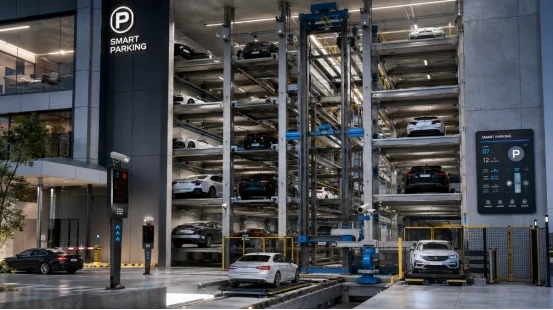
Lors de la conception d'un parking automatisé, les principaux facteurs à prendre en compte vont bien au-delà du simple choix des machines. Il faut un espace adapté, une circulation fluide, un accès sécurisé, des solutions de paiement appropriées, un logiciel fiable et un plan de maintenance efficace. Un bon système de parking automatisé doit résoudre les problèmes quotidiens, et non créer de nouvelles files d'attente autour d'un horodateur coûteux.
Le terme peut décrire un système de stationnement automatisé Il peut s'agir d'un système de stationnement mécanique ou d'un système intelligent gérant l'accès, le paiement, le guidage et l'historique des véhicules. Dans de nombreux projets, la collaboration entre ces deux aspects est indispensable. C'est pourquoi la conception d'un parking automatisé doit partir des besoins opérationnels réels plutôt que d'une simple liste de produits.
1. Vérifier les conditions du site et de la structure
La conception d'un système de stationnement automatisé commence par le bâtiment lui-même. Un agencement compact peut augmenter la capacité, mais seulement si la structure, les dimensions des véhicules, l'alimentation électrique, le drainage et l'accès pour la maintenance sont compatibles avec les équipements.
Mesurez l'espace que vous pouvez réellement utiliser.
Vérifiez les colonnes, la hauteur sous plafond, l'espace de manœuvre, les fosses techniques, les armoires de commande et les voies de maintenance. Prévoyez également un espace suffisant pour les files d'attente dans la zone de transfert. Un système de stationnement automatisé pour immeubles commerciaux peut connaître des pics d'affluence importants, tandis qu'un système pour immeubles résidentiels nécessite souvent un fonctionnement silencieux et un accès fiable tard le soir.
Définir les limites du véhicule à l'avance
Consignez la répartition prévue des berlines, SUV, fourgonnettes, motos et véhicules électriques. Les limites de hauteur et de poids des véhicules influent sur la plateforme, l'ascenseur, la disposition des capteurs et l'installation du système de stationnement automatisé. Modifier ces limites après la construction est rarement bon marché.
2. Planifier la circulation des véhicules et l'intégration au bâtiment
La fluidité du trafic dans un parking automatisé détermine si l'expérience finale sera perçue comme rapide ou frustrante. Attendre trente secondes à une barrière paraît beaucoup plus long qu'il n'y paraît, surtout avec cinq voitures derrière.
Concevoir les zones d'entrée, de sortie et de transfert
Modélisez le trafic de pointe, et non le trafic moyen. Prévoyez suffisamment d'espace pour que les véhicules puissent s'arrêter, faire marche arrière en toute sécurité et dégager la voie publique. Séparez les usagers enregistrés des visiteurs en cas de forte affluence. Dans un grand parking de plus de 19 000 places, les multiples voies d'entrée et de sortie géraient entre 50 et 60 véhicules par minute aux heures de pointe.
Guider les conducteurs vers le bon endroit
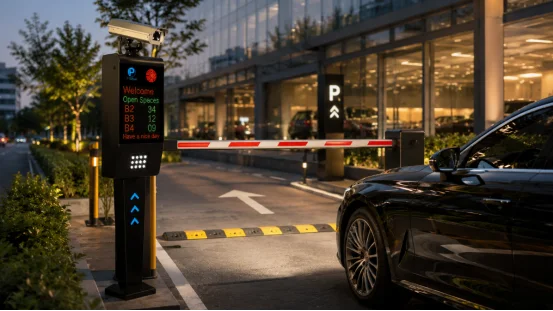
Un système de guidage de stationnement peut indiquer les places disponibles par étage et par zone. Des détecteurs à ultrasons font passer un voyant du vert au rouge lorsqu'un véhicule se gare, puis mettent à jour les panneaux d'affichage intérieurs et extérieurs. Dans un projet de 500 places de bureaux, ce système a permis de suivre l'occupation en temps réel, d'enregistrer les temps de stationnement, d'établir des statistiques et de contrôler l'accès. Moins de manœuvres en rond signifie une consommation de carburant réduite et moins d'irritations chez les conducteurs.
3. Associer technologie, coût et personnalisation
Le coût d'un système de stationnement automatisé comprend bien plus que le simple matériel. Les travaux de génie civil, les équipements de gestion des voies, le câblage réseau, les logiciels, la mise en place des paiements, la mise en service, la formation, les pièces de rechange et les évolutions futures sont autant d'éléments à prendre en compte.
Choisissez la méthode d'accès appropriée
Un Système de stationnement ANPR Le système lit la plaque d'immatriculation, enregistre l'heure d'entrée, ouvre la barrière automatique et vérifie à nouveau la plaque à la sortie. Un système de stationnement par reconnaissance de plaques d'immatriculation (LAPI) est adapté aux parkings sans ticket. Un système de stationnement ALPR remplit la même fonction sous une autre appellation courante.
Un système de stationnement RFID est idéal pour les employés, les locataires et les abonnés mensuels. Un système de tickets reste pratique pour les sites publics accueillant de nombreux visiteurs de passage. Certains projets combinent ces deux méthodes, ce qui est souvent plus judicieux que d'imposer une procédure unique à tous les conducteurs.
Logiciel de connexion et paiement
L'intégration d'un système de stationnement automatisé doit couvrir le système de paiement, le contrôle d'accès, les règles financières, les autorisations des utilisateurs et les plateformes tierces. Un bon logiciel de gestion de stationnement permet d'enregistrer les véhicules, de gérer les listes blanches et noires, de corriger les plaques d'immatriculation, de définir les tarifs par type de véhicule, d'afficher les images en temps réel des entrées et de générer des rapports sur les tarifs et le trafic. Avant d'approuver une solution de stationnement automatisée personnalisée, renseignez-vous auprès du fournisseur sur la disponibilité d'un kit de développement logiciel (SDK).
4. Aborder la sécurité et la conformité
Les exigences de sécurité relatives au stationnement automatisé doivent être abordées dès la première réunion de conception. Les réglementations locales en matière de construction, d'incendie, d'électricité, de circulation, d'accessibilité et de données peuvent modifier l'agencement et le processus d'exploitation.
Ajouter des contrôles de sécurité physique
Utilisez des détecteurs de véhicules, des capteurs d'obstacles, des arrêts d'urgence, un déverrouillage manuel, des feux de signalisation et un système anticollision. Une barrière reliée à un détecteur de véhicules peut se relever si un véhicule reste sous le bras. Précisez également la procédure à suivre en cas de véhicule trop volumineux, mal stationné ou laissé dans la zone de transfert.
Protection des dossiers et droits d'accès
L'accès aux images des plaques d'immatriculation, aux heures d'entrée, aux paiements et aux actions des opérateurs doit être contrôlé. Il est nécessaire de définir des rôles utilisateurs, des règles de conservation des données, des procédures de sauvegarde et des journaux d'audit. Le système doit également gérer les exceptions, car des tickets perdus et des erreurs de lecture de plaques d'immatriculation se produisent encore dans les parkings.
5. Concevoir pour la fiabilité et la maintenance
La fiabilité d'un système de stationnement automatisé est plus facile à concevoir qu'à réparer ultérieurement. Les équipements seront exposés à la poussière, à la chaleur, à la pluie, aux variations de tension, aux pannes de réseau et, parfois, aux conducteurs qui s'arrêtent au mauvais endroit.
Se préparer aux pannes de courant et de réseau
Utilisez l'alimentation de secours là où c'est nécessaire et déterminez quelles fonctions doivent continuer à fonctionner localement. système de stationnement hors ligne Il est possible de stocker les données d'entrée et de sortie en cas de panne de l'ordinateur de gestion ou du réseau local, puis de les télécharger une fois la connexion rétablie. Cela permet de maintenir un accès continu aux données essentielles.
Établir un plan de service pratique
La maintenance des parkings automatisés doit inclure le nettoyage des caméras, la vérification des capteurs, le test des barrières, la sauvegarde de la configuration, les mises à jour logicielles et la planification des pièces de rechange. Seul le personnel formé est habilité à intervenir sur les équipements du système. Avant de remplacer un appareil défectueux, coupez son alimentation et vérifiez d'abord son alimentation électrique. C'est simple, certes, mais cette étape permet d'éviter de nombreuses interventions inutiles.
6. Réduire les déchets et améliorer les opérations quotidiennes
L'automatisation du stationnement devrait permettre de gagner du temps et de l'espace. Les gains les plus appréciables proviennent souvent de la réduction des files d'attente, de la simplification des recherches, de la précision des données d'occupation et de la diminution de la charge de travail manuelle.
Suivi des données d'exploitation utiles
Analyser le taux d'occupation par heure, les heures d'entrée et de sortie, les exceptions de paiement, les temps d'arrêt des équipements et le temps de recherche. Une planification bien pensée système de gestion de stationnement Il est également possible d'obtenir des données sur les véhicules, l'activité des opérateurs et les frais de stationnement. Ces informations vous permettent d'adapter les règles de circulation et les effectifs en fonction de la situation réelle.
Plan pour l'énergie et la croissance
Un système de stationnement écoénergétique peut utiliser des capteurs basse consommation, des indicateurs LED, un éclairage intelligent et des modes veille pour les équipements. Prévoyez de l'espace pour ajouter des voies, des caméras, des bornes de paiement ou des bornes de recharge. Votre liste de contrôle pour un projet de stationnement automatisé doit inclure les possibilités d'extension avant que les travaux de câblage et de béton ne rendent les modifications difficiles.
Choisir un fournisseur de systèmes de stationnement automatisés
Une fois les six facteurs identifiés, le fournisseur du système de stationnement automatisé doit les transformer en un système fonctionnel. TigerWong Ce système offre un accès au stationnement, la lecture automatique des plaques d'immatriculation (LAPI et LAPI), la billetterie et la technologie RFID, le contrôle des barrières, le guidage au stationnement, le paiement en libre-service et un logiciel de gestion de parking. Ses fonctionnalités incluent l'enregistrement des véhicules, les règles de tarification, les listes blanches et noires, la surveillance en temps réel, la consultation des données, l'exportation des rapports, l'affichage multilingue et l'intégration logicielle.
Le fournisseur propose également des fonctionnalités personnalisées, des connexions via SDK, une assistance technique à distance, des tests en usine et une assistance sur site si nécessaire. Cette offre complète est essentielle, car une solution de stationnement automatisée est optimale lorsque le matériel, le logiciel, le paiement et le service sont conçus comme un projet unique, et non achetés séparément.
FAQ (questions fréquentes)
Q1 : Comment construire un système de stationnement automatisé ?
A : Commencez par la capacité, les dimensions des véhicules, les limites structurelles, le trafic de pointe, les méthodes d'accès, les règles de paiement, les exigences de sécurité, les liaisons logicielles, les tests et les responsabilités en matière de maintenance.
Q2 : Quels sont les facteurs qui influencent le coût d'un système de stationnement automatisé ?
A : La capacité, le niveau d'automatisation, les travaux de génie civil, le nombre de voies, la technologie de reconnaissance, l'équipement de paiement, l'intégration logicielle, l'installation et le service à long terme influent tous sur le total.
Q3 : Quelle méthode d'accès est la meilleure ?
A : La reconnaissance des plaques d'immatriculation convient aux véhicules sans billet, la RFID aux utilisateurs enregistrés et les billets aux visiteurs temporaires. Les sites mixtes peuvent nécessiter plusieurs méthodes.
Q4 : Le système peut-il continuer à fonctionner en cas de panne de réseau ?
R : Oui, lorsque les contrôleurs locaux prennent en charge le fonctionnement hors ligne et stockent les enregistrements pour une synchronisation ultérieure.
Q5 : Que doit inclure une liste de contrôle pour un projet de stationnement automatisé ?
A : Inclure les mesures du site, les limites de véhicules, le flux de circulation, les approbations de sécurité, la logique de paiement, la sécurité des données, l'alimentation de secours, les tests d'acceptation, la formation du personnel, la maintenance et l'espace d'expansion.