
Installing a full height turnstile involves more than bolting a tall gate to the floor. You need an entrance layout, a suitable foundation, protected power and data routes, a defined access-control interface, and an emergency plan. Dimensions and functions depend on the selected model and site.
This guide covers site work, wiring, safety checks, commissioning, and quotation inputs.
What Is a Full Height Turnstile?
A full height turnstile forms a tall enclosure around a pedestrian lane. A rotating internal tripod controls passage after the access-control system validates a person or ticket. The structure suits entrances that need a stronger physical separation than a waist-height gate can provide.
Full Height Turnstile Structure and Access Role
The turnstile can manage one-way or two-way passage according to controller settings. It provides a defined checkpoint for a factory perimeter, restricted service entrance, stadium, warehouse, or controlled campus. The barrier remains one part of the system; readers, controllers, cameras, alarms, and staff procedures still shape the complete access policy.
Where Is a Full Height Turnstile a Practical Fit?
Use the structure where a low barrier provides limited separation, the entrance sits on an open perimeter, or a narrow controlled lane needs supervision.
What Should You Check Before Installing a Full Height Turnstile?
Site preparation determines whether installation stays within the planned scope. Complete the measurements and responsibility split before the equipment is shipped.
Entrance Layout and Clear Passage
Record these items on the site drawing:
- Lane width, entry and exit direction, and queue space.
- Nearby doors, walls, columns, fences, and vehicle routes.
- An accessible bypass or staffed route where the site requires one.
- Camera view, lighting, signage, and emergency egress.
- Space to remove panels or reach the drive assembly during service.
Ground, Foundation, and Drainage
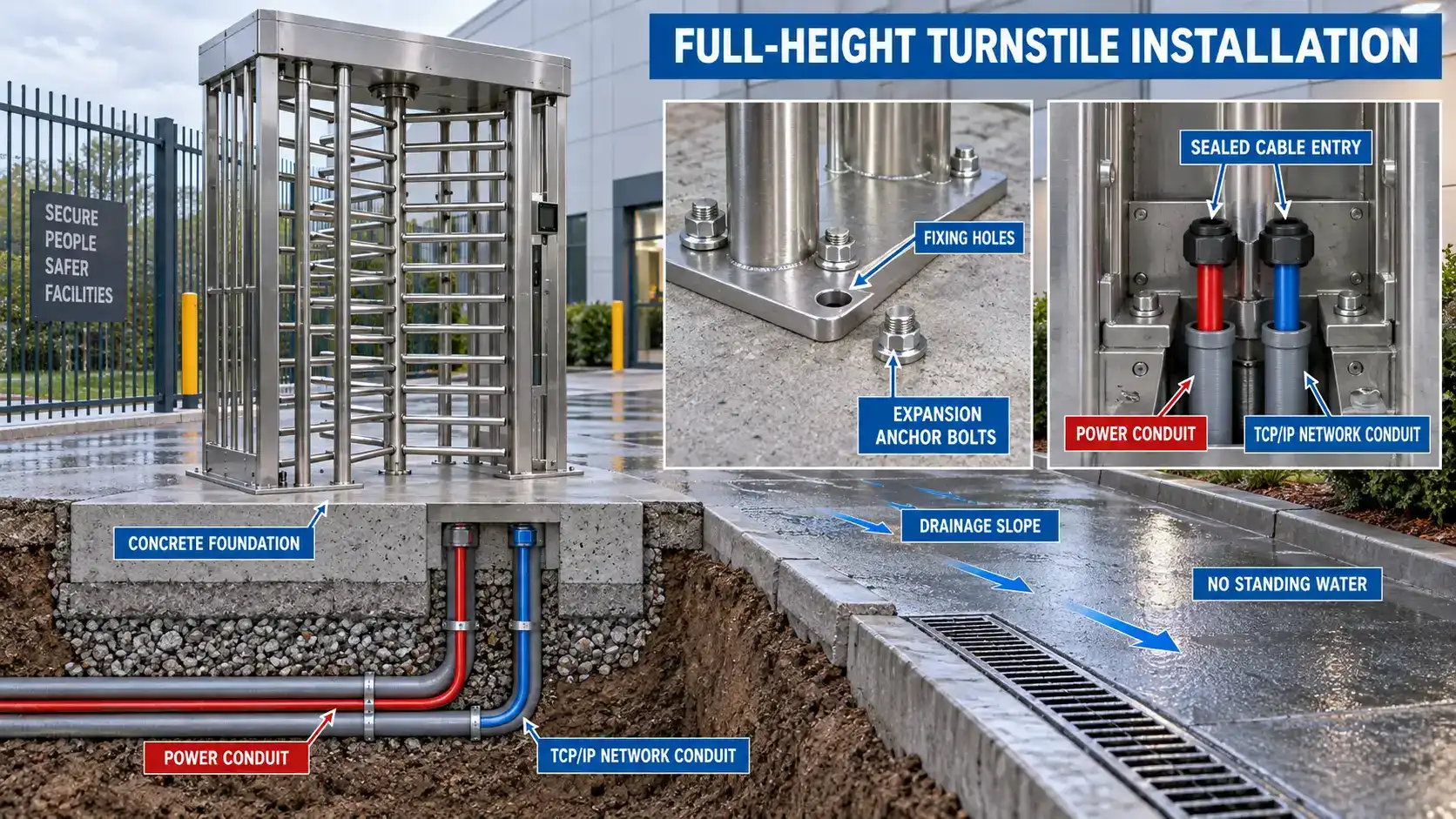
Confirm floor level, concrete condition, anchor locations, and the load path before drilling. Outdoor sites also need drainage, protection from standing water, and a route for conduits. Do not copy a generic foundation size from another project. Use the selected model drawing and local engineering requirements.
Maintenance and Camera Clearance
Leave access for inspection, cleaning, fastener checks, and replacement work. Keep cameras clear of the frame and provide lighting for operators and LED indicators.
How Do You Prepare the Site for Installing a Full Height Turnstile?
The equipment should arrive at a site with a documented installation plan covering civil work, electrical work, access-control wiring, software setup, and acceptance.
Delivery, Unpacking, and Component Check
Before assembly, compare the packing list with the approved quotation and drawing. Check the housing, rotating assembly, reader parts, controller, fasteners, cables, and installation documents.
Power, Network, and Control Cabling
Mark power, network, reader, emergency, and controller routes. Protect cables in conduit, keep service loops accessible, and confirm grounding, voltage, and backup supply requirements.
Selected full height turnstile models in TigerWong materials reference TCP/IP communication. Other access-control devices may use Wiegand or RS485. Confirm the interface for the exact model, controller, cable type, and software platform before cable installation.
Reader and Credential Position
Choose the reader location by user flow and credential type. Proximity or IC/ID cards need a clear tap area. Barcode and QR code readers need a visible scanning angle. Biometric or facial-recognition devices need a suitable height, lighting, and distance. Put these positions on the approved drawing so the installer does not improvise after the frame is fixed.
How Is a Full Height Turnstile Connected to Access Control?
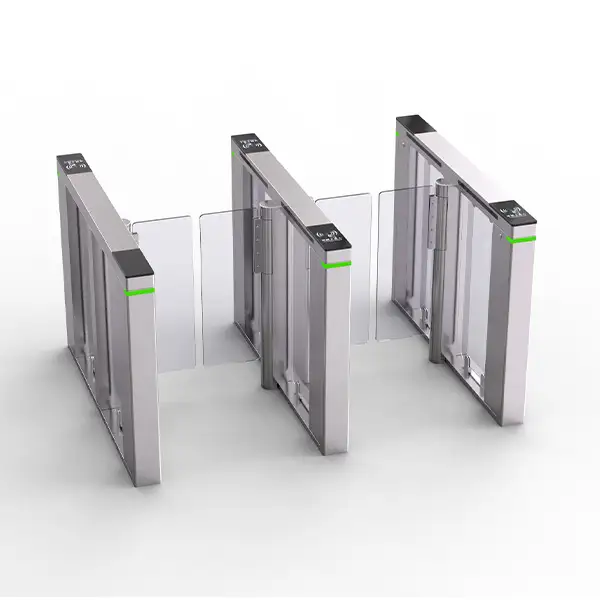
The gate, reader, controller, and software need a defined event sequence from credential presentation to recorded passage.
Credential Options
Selected TigerWong full height turnstile models can integrate with proximity cards, biometric readers, barcode and QR code readers, and facial recognition. The supported credential depends on the reader and controller configuration. Confirm card technology, QR format, biometric device, fallback method, and visitor rules in the system specification.
Communication Interfaces
Ask for a wiring diagram and interface description. Confirm whether the proposed gate uses TCP/IP directly or connects through a controller using Wiegand, RS485, API, or SDK functions. A protocol name alone does not confirm compatibility; test the actual device and software combination.
Online and Offline Operation
Some access-control configurations support central online management, while selected devices can retain defined recognition or access functions offline. Confirm stored permissions, event buffering, time settings, and recovery behavior before commissioning.
What Safety Functions Should You Verify During Installation?
Safety behavior belongs in the installation checklist and acceptance record. It should be tested with the actual power, reader, controller, and emergency inputs.
Emergency Release and Power Failure
TigerWong materials describe selected full height models with an emergency function that allows the internal tripod to rotate freely for evacuation. Verify the trigger, power-failure state, manual release, reset sequence, and reauthorization process for the chosen model.
Directional and Passage Sensors
Check how the system detects direction, incomplete passage, reverse movement, and repeated entry attempts. Confirm sensor alignment after the structure is anchored. Record the expected controller response for each test case.
LED Authorization Indicators
Selected full height models use LED indicators for Go and No Go or card authorization status. Confirm that the colors and signals match the access policy and that operators can read them in the installed lighting conditions.
How Do You Test a Full Height Turnstile After Installation?
Commissioning should cover the mechanical assembly and access-control workflow. A signed test record gives maintenance staff a service reference.
Mechanical and Alignment Checks
Inspect vertical alignment, anchor tightness, rotating clearance, panel gaps, and smooth movement. Check that the turnstile does not contact fences, doors, signs, or nearby equipment through its full rotation.
Credential and Direction Tests
Test valid and invalid cards, QR codes, biometric credentials, or facial-recognition inputs supported by the project. Check entry, exit, one-way, two-way, and denied-direction behavior. Confirm that each approved passage creates the expected event in the management system.
Emergency and Recovery Tests
Test emergency release, power restoration, network interruption, manual reset, sensor response, and event recovery. Repeat the sequence after software settings are finalized. Small configuration changes can affect the result, so the final test should use production settings.
Operator Handover
Provide the approved drawing, wiring diagram, controller settings, emergency procedure, maintenance notes, and acceptance record. Train operators on authorization, denied access, manual release, and fault reporting.
What Should You Ask a Full Height Turnstile Supplier?
Supplier review should focus on model fit, documents, and project responsibilities. A complete technical response helps you separate equipment supply from civil, electrical, software, and local installation work.
Model and Drawing Confirmation
Request the exact model, lane dimensions, overall footprint, fixing method, reader position, power data, communication interface, and emergency behavior. Ask the supplier to mark standard items and customized items on the drawing.
Customized Hardware and Software
TigerWong Technology Co., Ltd supplies turnstile, access-control, smart parking, and facial-recognition equipment. Its materials list tripod, flap, swing, sliding, speed, half-height, and full-height families. The R&D team can support software modification and hardware manufacture for project requirements, with OEM/ODM and appearance customization mentioned in the supplied materials.
Send the site plan, lane count, credential method, controller, environmental conditions, customization needs, and acceptance targets through the official project contact to request model guidance or a quotation basis.
How Should You Prepare a Full Height Turnstile RFQ?
An RFQ works best when it includes the site conditions that affect installation. Use this list to prepare a practical request.
Site and Traffic Information
Include site type, photos, layout, number of lanes, flow direction, peak periods, indoor or outdoor exposure, accessible route, camera positions, drainage, and emergency egress.
Access Control and Network Information
List reader type, controller, software platform, communication interfaces, online/offline rules, visitor credentials, and event records.
Delivery and Acceptance Information
State destination, installation split, documentation language, commissioning scope, local code review, and acceptance criteria. Ask the supplier to identify assumptions before the purchase order.
FAQ는
질문 1: What Is a Full Height Turnstile?
에이: It is a tall pedestrian access gate with a rotating internal barrier. The structure creates a controlled lane for restricted perimeters, factories, stadiums, warehouses, and similar sites.
질문 2: Can a Full Height Turnstile Be Installed Outdoors?
에이: Outdoor use depends on the selected model, site drainage, foundation, power protection, temperature, and local engineering requirements. Confirm environmental suitability in the model documentation.
질문 3: What Foundation Does a Full Height Turnstile Need?
에이: The foundation and anchor layout must follow the selected model drawing and site engineering review. Check floor level, concrete condition, fixing points, conduit routes, and drainage before drilling.
4분기: Can a Full Height Turnstile Connect to RFID, QR Code, or Facial Recognition?
에이: Selected models can integrate with proximity or IC/ID cards, barcode and QR code readers, biometric readers, and facial recognition. Confirm the reader, controller, protocol, and software behavior for the exact configuration.
질문 5: What Should Be Tested After Installing a Full Height Turnstile?
에이: Test mechanical alignment, valid and denied credentials, direction logic, sensors, LED signals, emergency release, power recovery, network recovery, event records, manual reset, and operator procedures.