
A turnstile is a physical gate that controls pedestrian entry and exit. It releases a lane after a person presents an approved credential, then manages passage one person at a time. You may see one at a metro station, office lobby, factory entrance, school, stadium, or car park.
The device forms one part of an access-control system. A reader identifies the credential, a controller checks permission, and software records the event. This guide explains the process, compares common turnstile types, and shows what to check before selecting a system.
What Is a Turnstile?
A turnstile combines a physical barrier with a controlled passage rule. The barrier may use rotating arms, swinging panels, sliding glass, or a full-height cage. Structure, reader, controller, sensors, and software work together according to the site policy.
A Physical Gate for Controlled Pedestrian Flow
A basic turnstile creates a defined lane for one-way or two-way movement. It gives staff a visible checkpoint and supports a clear entry rule.
El NIST access control glossary defines access control as granting or denying requests to use facilities, information, or resources. In a physical entrance, the turnstile acts on that decision by releasing or holding the barrier.
Mechanical and Electronic Turnstiles
Mechanical turnstiles rely on the user’s push after a valid release. Electronic turnstiles use a motor, sensors, and a controller to manage movement. Electronic models can support event records, directional logic, emergency behavior, and integration with a wider access platform.
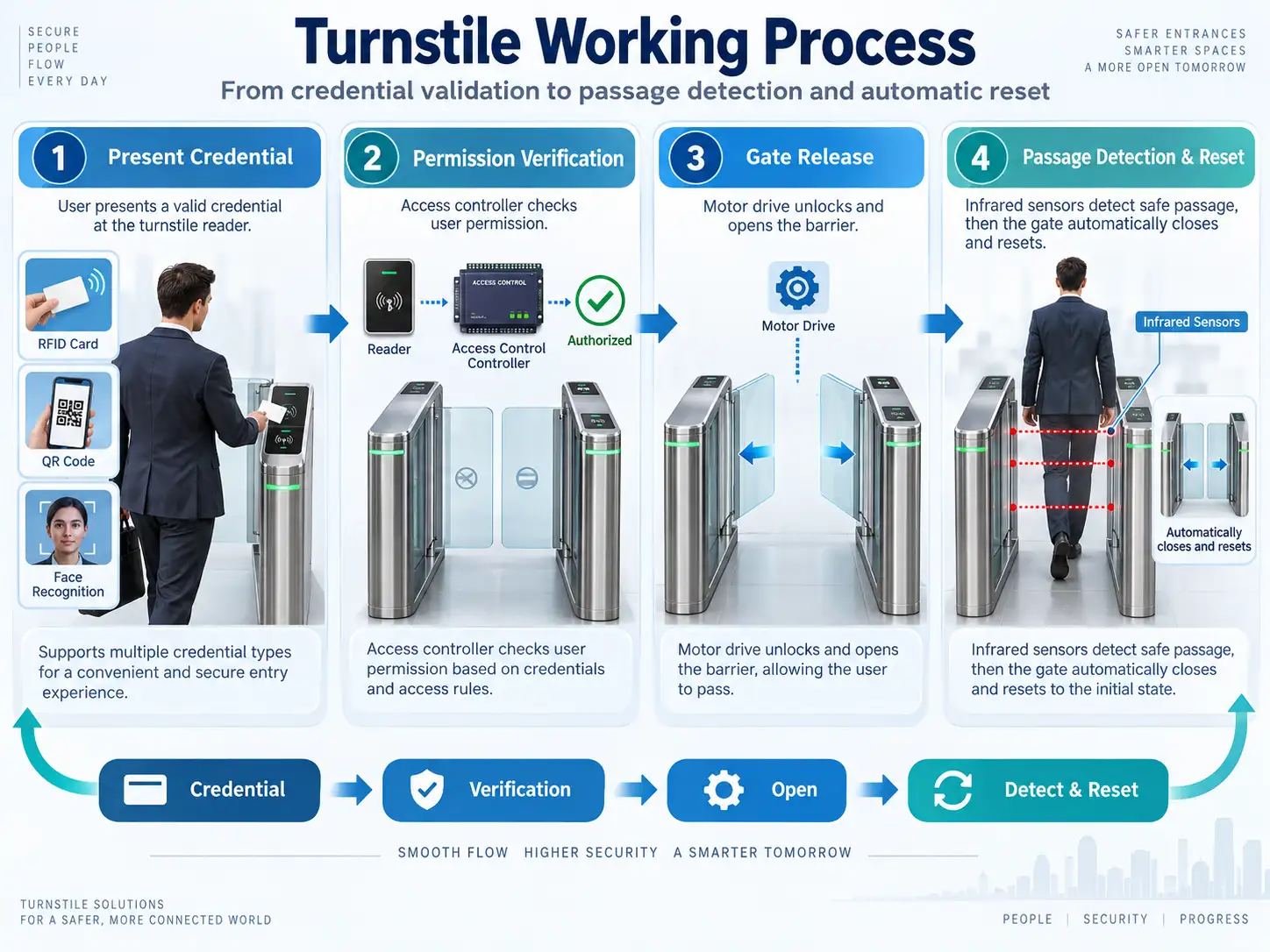
How Does a Turnstile Work?
Each stage needs a clear project decision: which credential is accepted, where validation occurs, what the controller sends to the gate, and what happens during a fault or emergency.
Credential Presentation and Permission Check
A reader may accept an IC or ID card, proximity card, RFID device, barcode, QR code, biometric credential, or facial-recognition input, depending on the selected model. The controller or software checks permission, schedule, direction, or visitor status. A valid result releases the lane; an invalid result keeps the barrier closed and may create an event record.
Gate Release, Passage Detection, and Reset
After authorization, the motor or locking mechanism moves the barrier. Sensors can detect direction and passage, helping the controller close or reset the lane. LED indicators commonly show standby, authorization, or passage status on selected models.
Reader response time, network delay, lane width, and user behavior all influence operation. A supplier proposal should describe the complete sequence and the gate cabinet.
Emergency Release and Directional Logic
Emergency behavior varies by structure and model. Selected tripod turnstiles can drop the arm, while selected flap and swing gates can open for evacuation. Safety and directional sensors can help manage passage logic. Confirm the trigger, power-failure behavior, reset method, and manual release procedure for the exact model.
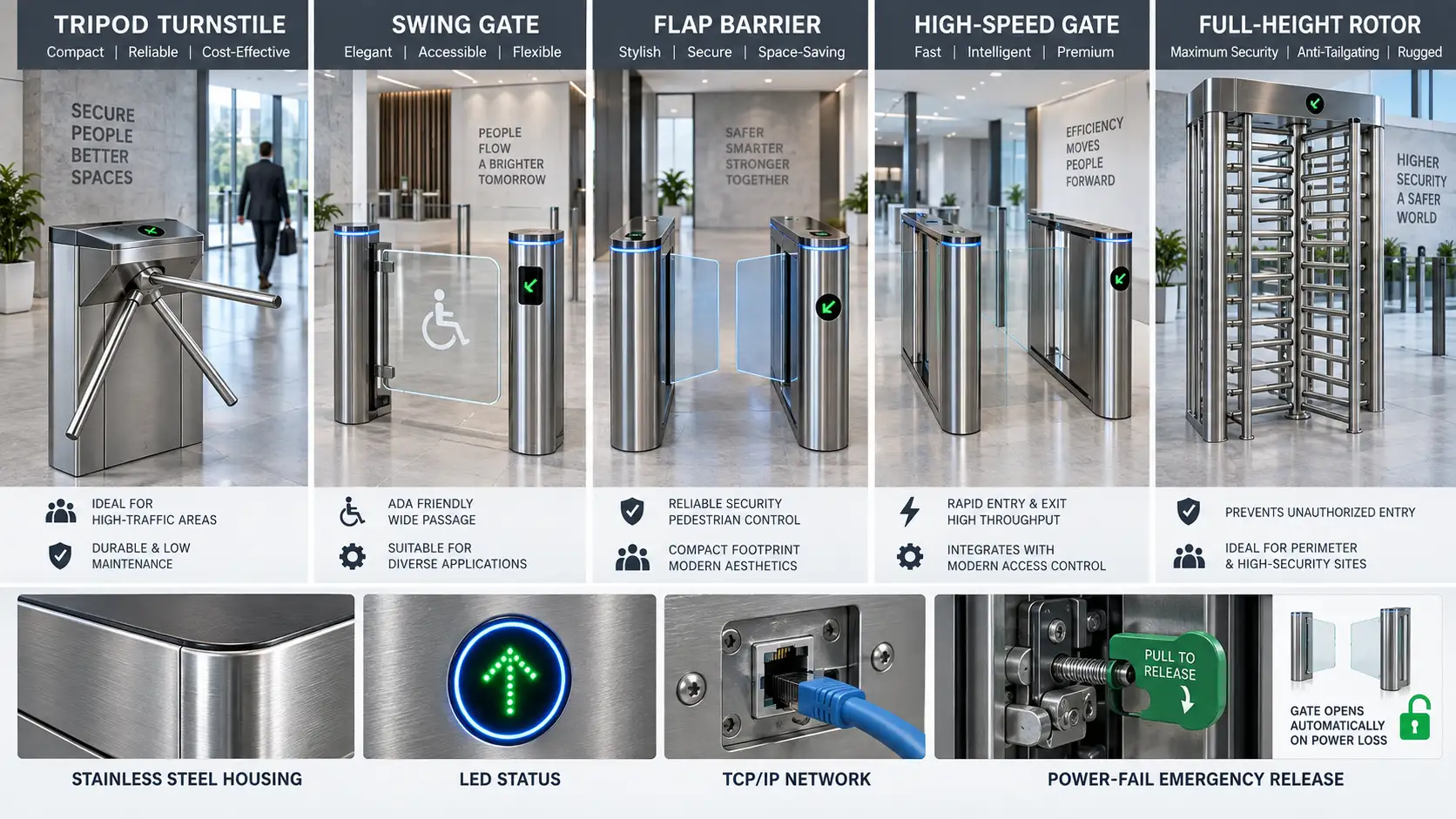
What Are the Main Types of Turnstiles?
Different structures suit different traffic patterns, security objectives, architectural settings, and accessibility needs. Final selection depends on the entrance drawing and operating policy.
| Turnstile Type | Typical Fit | Points to Check |
| Trípode | Offices, factories, schools, gyms | Lane width, arm drop, reader position |
| Flap | Indoor lobbies and controlled public entrances | Accessible lane, sensors, emergency opening |
| Swing | Offices, schools, venues, wider passages | Panel travel, clear space, direction control |
| Optical | Design-focused interiors | Sensor detection and barrier policy |
| Speed gate | High-flow reception areas | Throughput conditions and safety |
| De altura completa | Restricted perimeters | Foundation, maintenance, evacuation route |
| Drop-arm | Controlled lanes | Arm release and reset process |
Trípode torniquete
A tripod turnstile uses three rotating arms and a compact footprint. TigerWong materials describe tripod families for offices, theatres, museums, theme parks, and other controlled entrances. Selected models list card, barcode, QR code, biometric, and facial-recognition integration.
Some listed models reference 25 to 35 or 30 to 40 people per minute, excluding card validation time. These figures apply to the listed models and conditions.
Flap and Swing Turnstiles
Flap gates use retractable panels, while swing gates move a panel sideways. TigerWong materials list both structures for offices, theatres, museums, theme parks, and similar indoor settings. Selected models use polycarbonate panels, LED authorization indicators, safety sensors, and TCP/IP communication.
Check clear opening, nearby doors, sensor position, and emergency release before approval.
Optical, Speed, Full-Height, and Drop-Arm Designs
Optical turnstiles use sensors to manage passage with little or no physical barrier. Speed gates use moving glass or panels. Full-height turnstiles form a taller enclosure for restricted perimeters, while drop-arm designs lower the horizontal barrier for a defined emergency route.
Foundation details, drainage, lighting, camera coverage, and maintenance access matter alongside the barrier style.
Where Are Turnstiles Used?
The same access rule looks different across a city. A transit station needs fast credential handling, while a school may prioritize supervised entry and an accessible route.
Offices, Schools, and Commercial Buildings
Entrances often separate employees, students, visitors, and contractors. Card readers can serve regular users, while QR codes support temporary access. Swing or flap gates can provide a clearer accessible passage when the layout allows it.
Transit Stations and Public Venues
Stations, stadiums, museums, and exhibition venues connect ticket validation with controlled pedestrian flow. Review peak periods, reader placement, queue space, emergency egress, and cleaning access together.
Factories, Restricted Sites, and Outdoor Perimeters
Factories may link turnstile events with attendance or area permissions. Outdoor projects need confirmation of temperature, rain and dust exposure, foundation details, drainage, power quality, and network routing.
What Should You Check Before Choosing a Turnstile?
A suitable turnstile starts with site information. Put the operating rule, hardware, software, and acceptance checks into one project record.
Security Level, Traffic, and Accessibility
Define who may enter, in which direction, and during which time window. Record peak flow, staffed supervision, accessible routes, nearby doors, cabinet length, and maintenance space. The turnstile supports the policy alongside cameras, alarms, guards, and building procedures.
Reader, Controller, and Communication Protocol
Ask for the exact reader and controller arrangement. Selected TigerWong devices reference TCP/IP, Wiegand, RS485, API, and SDK connections. Confirm which interface belongs to the proposed model and test it with the existing platform.
El SIA OSDP resource provides context on supervised device communication. A project test confirms the specific turnstile integration.
Emergency Behavior and Acceptance Test
Write down release triggers, power-failure behavior, sensor response, LED signals, manual override, event records, and reset steps. Test these items before a wider rollout.
How Can a Turnstile Connect to a Wider Access-Control System?
Turnstile access control depends on the connection between credentials, controller logic, and management software. A working demonstration should show the full event path from credential presentation to recorded passage.
Credentials and Visitor Workflows
Cards suit repeat users, QR codes can support temporary tickets, and biometric or facial-recognition readers can support projects with approved identity policies. Confirm consent, data retention, local privacy rules, and fallback credentials before deployment.
Online and Offline Operation
Some products support online synchronization, while selected devices can continue defined recognition or access functions offline. Ask for offline rules, stored-data behavior, time settings, and the recovery process.
How Does a Turnstile Supplier Support Project Requirements?
Supplier support matters when a site needs a modified cabinet, reader position, software behavior, or integration test.
Customized Hardware and Software
TigerWong Technology Co., Ltd supplies smart parking, access-control, turnstile, and facial-recognition equipment. Its listed families include tripod, flap, swing, sliding, speed, half-height, and full-height structures. The knowledge base records software modification, hardware production for project requirements, OEM/ODM, appearance customization, and technical installation guidance.
Send layout, lane count, credential method, controller, software platform, environmental conditions, customization needs, and acceptance targets through the official project contact to request a model recommendation or quotation.
Preguntas frecuentes
P1: What Is a Turnstile?
A: A turnstile is a mechanical or electronic pedestrian gate that controls entry and exit, usually releasing one person after credential validation.
P2: How Does a Turnstile Work?
A: A reader captures a card, code, biometric credential, or face image. The controller checks permission, releases the barrier, detects passage, and returns the lane to its configured state.
P3: What Are the Main Types of Turnstiles?
A: Common types include tripod, flap, swing, optical, speed, full-height, and drop-arm turnstiles. Selection depends on traffic, space, accessibility, security policy, and emergency planning.
P4: Can a Turnstile Support RFID, QR Code, or Facial Recognition?
A: Selected models support RFID or IC/ID cards, QR codes, barcodes, biometric readers, or facial recognition. Confirm the reader, controller, protocol, and software behavior for the exact model.
P5: What Should You Check Before Buying a Turnstile?
A: Check lane dimensions, traffic pattern, accessible passage, reader type, communication interface, emergency behavior, installation scope, spare parts, documents, and acceptance criteria.