
Installing a Speed Gate Turnstile requires a suitable lane layout, stable foundation, correct wiring, and tested safety signals. This guide covers a commercial project from site preparation to commissioning and maintenance. The selected model manual always takes priority because dimensions, terminals, voltage, and interfaces can vary.
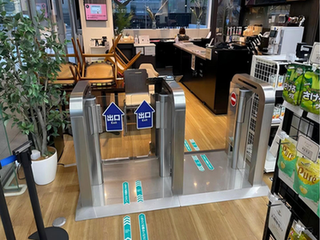
Why Speed Gate Turnstile Installation Planning Matters
Good planning defines the lane width, cable route, power point, and testing plan before equipment arrives. It also coordinates construction, access control, fire safety, and network work.
Confirm traffic flow and lane layout
Record the entry and exit lanes, travel direction, required lane width, nearby doors, and accessible routes. Leave space for users to approach the reader, pass through the panels, and clear the gate. Mark directions on the drawing so sensors, readers, and alarms can be configured consistently.
Check the installation surface and environment
A Speed Gate Turnstile needs a flat, level, cured platform. Confirm concrete strength and thickness with the project engineer, then compare the finished floor with the model’s anchor layout. Check moisture, dust, vibration, sunlight, heat, service access, and conduit separation from high-voltage circuits.
What Should You Prepare Before Installation?
The preparation stage connects the product specification with the building. A short meeting with the installer, electrician, access control integrator, and fire safety contact can resolve issues before drilling.
Review drawings, tools, and the product model
Prepare the approved layout, foundation drawing, wiring diagram, network plan, and emergency egress requirements. Confirm cabinet positions, reader locations, and opening direction. Typical tools include a laser level, concrete drill, torque tools, cable labels, multimeter, and protective equipment.
For project selection, review the Speed Turnstile Gate product range and compare the lane dimensions, drive type, sensor layout, and access control requirements for each model.
Prepare power, network, and safety wiring
Provide a dedicated supply that matches the model manual and local regulations. Install conduit before fixing the cabinets and label cables at both ends. Separate mains, low-voltage, network, reader, fire alarm, and sensor cables as required. Confirm the emergency-open source and the fail-safe or fail-secure behavior required by the building and fire code.
Inspect the cabinets and accessories
Check the cabinet finish, panels, motor, infrared sensors, controller, brackets, keys, fasteners, and spare parts against the packing list. Report missing or damaged parts before installation.
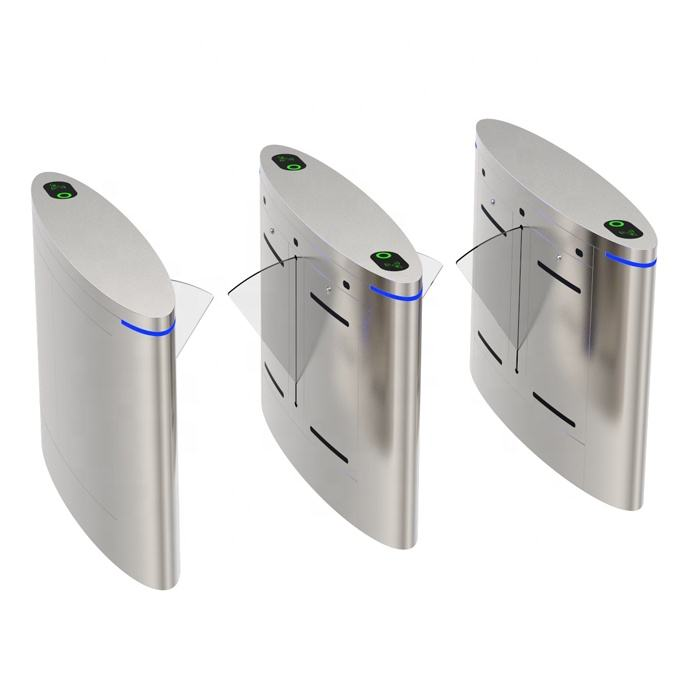
How to Install a Speed Gate Turnstile Step by Step?
The following sequence suits a typical indoor or sheltered installation. The model manual, approved drawings, and local regulations control the final work.
Step 1: Unpack and inspect the equipment
Move each cabinet close to its final position with protective film in place. Check doors, panels, and loose hardware, then record the equipment condition.
Step 2: Position the cabinets and mark anchor points
Place the cabinets according to the lane drawing. Use a laser level, check the gap at several points, and confirm the panel clearance. Recheck the lane centerline, reader height, approach distance, and accessible route before marking anchor holes.
Step 3: Drill holes and install anchors
Move the cabinets away from the marks and drill to the anchor manufacturer’s requirements. Remove dust, install the specified anchors, and check embedment. Leave final tightening until alignment and cable routing have been verified.
Step 4: Route conduit, cables, and grounding wires
Bring cables through the planned entry points without excessive bends. Label cabinet, function, and terminal at both ends. Connect protective grounding before power is applied, leave service length for maintenance, and seal unused openings.
Step 5: Connect the master and slave cabinets
Follow the terminal diagram for the master controller, slave cabinet, motor, infrared sensors, indicators, and alarms. Check polarity, terminal numbers, and connector locks. Connect card, QR, face, or biometric readers through the supported Wiegand, RS485, TCP/IP, or other specified interface, then apply the approved network plan.
For a product-specific reference, review the TGW-SG024 Speed Turnstile Gate page alongside the project wiring documentation. Product pages help with model identification; the supplied electrical diagram controls the actual terminal work.
Step 6: Power on and configure the first test
Before energizing the gate, inspect terminals, loose strands, and cabinet doors. Apply power under supervision and watch for abnormal noise, heat, vibration, or error indicators. Configure opening duration, direction, operating mode, panel speed, alarms, and sensor sensitivity for the approved use case.
Step 7: Integrate readers and emergency signals
Test the path from credential presentation to panel movement. Confirm the reader signal, event record, direction, fire alarm input, and emergency release logic with the responsible safety contact.
Step 8: Complete commissioning and handover
After functional tests pass, tighten anchors to the specified torque, refit covers, remove protective film, and clean the cabinets. Hand over wiring diagrams, parameters, network settings, maintenance instructions, test records, and emergency procedures.
How Do You Integrate Access Control and Safety Functions?
A Speed Gate Turnstile combines identity verification, control logic, sensors, alarms, and emergency release. Each device should produce a defined result for valid, invalid, delayed, and emergency signals.
Select the access control method
The entry point may use proximity cards, QR codes, face recognition, fingerprints, or a combination. Position readers so users present credentials from outside the moving-panel area. Keep permission groups and direction rules consistent across entrances.
You can compare compatible readers and controllers in the حلول التحكم في الوصول range. Confirm protocol, power, database, and offline behavior before placing the order.
Configure safety functions
Infrared sensors can detect a person in the lane and help prevent panel contact. Configure anti-pinch, anti-tailgating, reverse-entry, timeout, obstruction, and emergency-open responses according to the risk assessment. Never bypass a sensor to hide a commissioning fault.
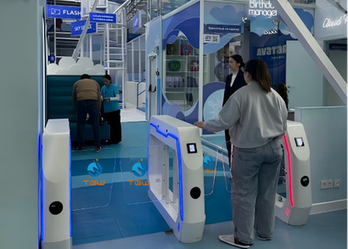
What Should You Test After Installation?
Use a written commissioning checklist and record each result. Testing should cover the credential, gate mechanism, and management software.
Mechanical and electrical checks
Confirm cabinet level, panel alignment, anchors, grounding, cable strain relief, and cover fit. The gate should open and close smoothly; scraping or excessive noise indicates a fault.
Entry, denial, and direction checks
Use authorized, expired, and unknown credentials. Verify direction, opening duration, event record, and alarm response on both entry and exit lanes where applicable.
Tailgating, reverse, and obstruction checks
Follow the site method for tailgating, reverse movement, and obstruction. Perform sensor-zone tests under trained supervision and repeat them after changing opening time or sensitivity.
Fire, power, and emergency checks
Activate the approved fire alarm input and emergency release device. Confirm the required safe state and operator event. Test recovery after power restoration, controller restart, and network interruption.
For networked projects, a compatible TCP/IP access controller can support communication between the gate, reader, and management layer. Record the final IP address, firmware version, and administrator handover details.
How Can You Maintain a Speed Gate Turnstile After Installation?
Maintenance keeps the lane predictable and reveals sensor, connector, or moving-part problems early.
Follow a routine inspection schedule
Disconnect power before electrical or mechanical maintenance. Clean stainless steel with a soft cloth, remove dust from sensor windows, check fasteners and cable glands, and look for moisture or corrosion. Review logs for repeated obstruction, tailgating, or motor faults. Follow the model manual for lubrication, drive inspection, and parameter changes.
How تيجر وونغ Supports Speed Gate Turnstile Projects
Shenzhen TigerWong Technology Co., Ltd. supplies turnstile and parking access products for projects in more than 155 countries and serves over 10,000 customers. Its turnstile range includes stainless steel SS304 construction, infrared sensing, alarm functions, TCP/IP connectivity, and integration with cards, QR codes, biometrics, and face recognition, depending on the selected model. Documented product lines include models rated for approximately 30–40 people per minute excluding credential validation, while certain models list a lifecycle of up to 5 million operations. Project support can include product selection, customization, testing, technical guidance, and after-sales assistance.
أسئلة متكررة
Q1: How do you install a Speed Gate Turnstile?
A: Confirm the layout and foundation, inspect the equipment, position and anchor the cabinets, route power and control cables, connect readers and safety inputs, configure the controller, and complete mechanical, access, emergency, and recovery tests.
Q2: What foundation does a Speed Gate Turnstile need?
A: It needs a flat, level, cured platform with enough thickness and strength for the specified anchors. Follow the model drawing for anchor spacing, embedment, drainage, service clearance, and any raised base requirement.
Q3: How do you wire a Speed Gate Turnstile to access control?
A: Use the supplied terminal diagram to connect the reader, controller, motor, sensors, alarm input, emergency release, network, and grounding. Match the access protocol and power requirements, label both ends of each cable, and test the complete authorization signal before final tightening.
Q4: What safety tests are required after installation?
A: Test authorized and denied credentials, direction control, opening time, infrared detection, anti-tailgating, reverse entry, obstruction response, fire alarm release, emergency opening, power recovery, and network interruption.
Q5: How often should a Speed Gate Turnstile be maintained?
A: Inspect and clean the gate on a schedule based on traffic, dust, humidity, and the manufacturer’s instructions. High-traffic sites need more frequent sensor, fastener, cable, and event-log checks than lightly used indoor entrances.